A Haunting Encounter with Lucy Raven’s Murderers Bar
by Anna Tanner
February 13 2026
As I enter the dark hallway leading into Lucy Raven's immersive installation work, Murderers Bar, I hear what sounds like a loud gunshot reverberating off the padded dark walls around me. I round the dark corner, and the dimly lit room opens up to reveal the culprit of the loud sound, an ominous, tall, warped metal wall, positioned askew in the center of the room. On the warped wall is a projection of what I had expected to be some kind of violent imagery, but instead is landscape drone footage flying above a river, swiftly moving the viewer closer towards a large dam.
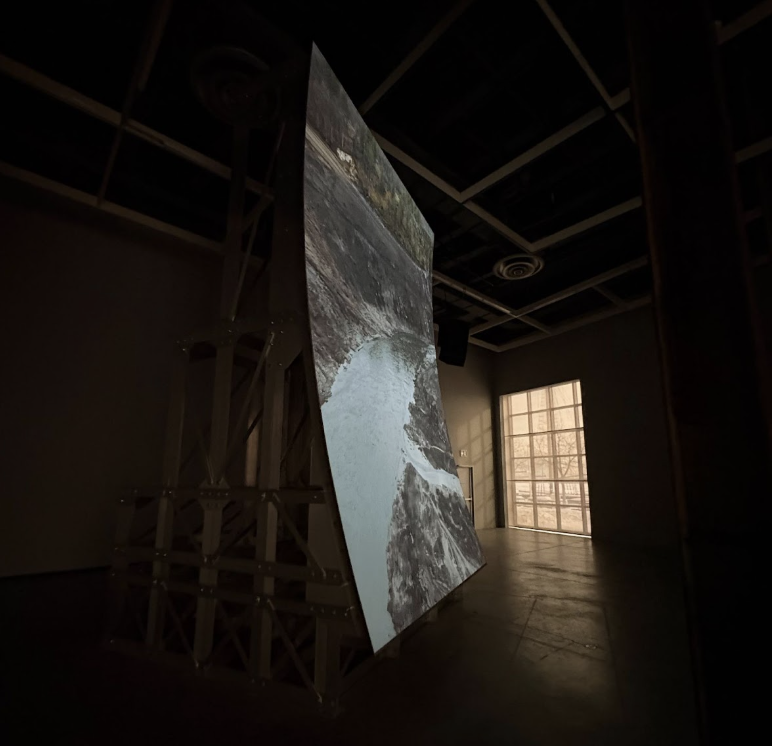
Lucy Raven, Murderers Bar
The drone transitions from flying far above the river, to flying right above the surface, occasionally dipping into the water causing an abrasive sound interference that amplifies as it bounces off the metal structures. At times I am forced to look away from the film due to motion sickness, which almost seems intentional. I stand so overwhelmed by the loud sounds and the fast visuals in the projection, that it takes me a moment to notice the bleachers positioned gazing directly at the industrial form. The bleachers are eerily reminiscent of classic American high school bleachers, but empty of people, leaving me alone to take in the bizarre scene.
Murderers Bar does an effective job of exactly that, creating ghostly allusions to human interference, without directly spelling it out to its viewers. The bleachers feel haunting as if there should be a crowd already seated, watching the destruction of the landscape. There are references to war throughout the installation, with the occasional gunshot sound echoing through the room and the footage in the film captured by a high-tech military drone. The dam in the film refers to the Klamath River and the violence and displacement against Indigenous residents after the construction of hydroelectric dams. Raven is presenting what clearly communicates as a tumultuous history embedded within the land. The land holds this history with its ecosystems forever changed after the impacts of the extractive and dominant powers of the American West. With the combination of unsettling sounds and fast, fleeting imagery, it is clear that there is something running powerful and violent within the now human-less landscape.
Connecting the artist's intent to the installation, the warped structure communicates a new meaning of collapsing into itself, pointing to the collapse of the natural world and Indigenous communities in the wake of the dam. As I walked further around the gallery I found myself walking back to Raven’s installation. The sensory stimulation being almost unbearably disorienting at times compels me to continue engaging with the work, wanting to tough it out and feel the impact the artist is communicating.
Raven’s central theme, demystifying the narrative around “The Great American West” is critiqued subtly and powerfully through the use of sensory consuming elements paired with industrial structures and unsettling visuals. Against the background of the current climate in America, Murderers Bars contributes to an active and contemporary discourse on the cycles of violence that are tied to the impacts of colonialism and embedded within the history of the land. Leaving me with the feeling that everything is never as it seems, and power should always be questioned.